
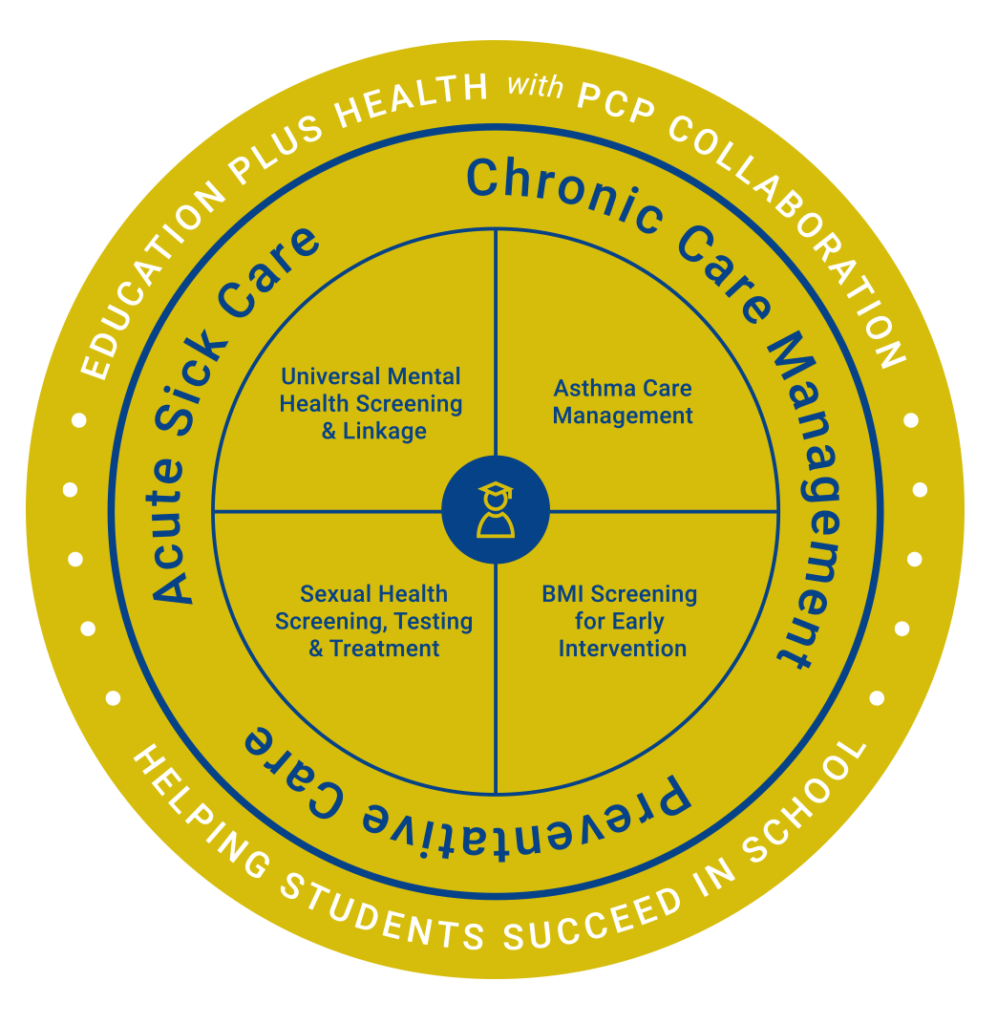
Education Plus Health provides a unique blend of Nurse Practitioner-led primary care and school nursing within it’s school-based health center model. In addition to nursing, our centers are staffed with Behavioral Health Counselors and Community Health Workers, and support from a Nutritionist.
School Nursing & Nurse Practitioners:
- Acute care, chronic disease management, and preventive care including sports physicals
- Diagnoses and treatment of acute and chronic illness
- Care management, coordination, and referrals in collaboration with primary care physicians and specialists
- Universal screening and assessment for mental health, substance use and abuse, sexual health, obesity, and asthma control
- Sexual and reproductive healthcare for teens
- Education and population health efforts to school community
Behavioral Health Counselors:
- Provide brief therapeutic intervention to students in grades 6-12 as needed and consented for
- Conduct trauma-focused cognitive behavioral therapy (TF-CBT) where appropriate
- Work in collaboration with school counselors and social workers to ensure wraparound care for students
Community Health Workers:
- Provide asthma and nutrition education
- Support families with insurance navigation
- Connect students and families to community resources to address social determinants of health such as food insecurity, housing, clothing, and other basic needs
Benefits of School-Based Health Centers
- Students who use school-based health centers have better grade point averages, get more physical activity, and eat more healthy foods than their counterparts.
- School-based health centers reduce absenteeism, emergency room utilization, hospitalization, and Medicaid costs overall—particularly for children with chronic health conditions like asthma.
- School-based health centers increase the use of primary care particularly for vulnerable youth who live in poverty, and for adolescents, one of the groups most likely to lack routine preventive care.
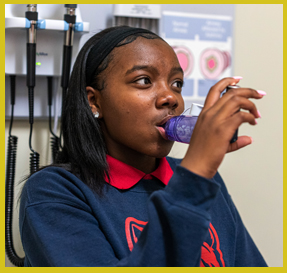
- Asthma management in school-based health centers decreases hospitalization rates by up to 75-85% and improves the use of peak flow meters and inhalers, saving approximately $970 per asthmatic child per school year.
- Students with access to school-based health centers are more likely to get reproductive preventive care, be screened for a sexually transmitted disease or infection, receive sexual health education, and use protection or abstain from sexual activity.
- School-based health centers reduce Medicaid expenditures related to inpatient, drug, and emergency department use.
- Mental health counseling has been repeatedly identified as the leading reason for student visits.
- One study found that “inner-city students were 21 times more likely to make mental-health related visits to school-based health centers than to community health centers.”
Nutritionist/Wellness Coaching:
- Provide 1:1 and group nutrition and wellness coaching to students, as consented by their parents
- Educate students on healthy lifestyle habits such as nutrition, physical activity, sleep, and mental well-being
Get Involved
Education Plus Health is a member of the Pennsylvania School-Based Health Alliance (PSBHA), the state affiliate of the National School-Based Health Alliance. PSBHA was founded in 2020 in partnership with Education Plus Health and has it’s own 501(c)3 status and Board of Directors. For more information, visit PSBHA.
To bring a center to your school, email contact@educationplushealth.com.
References
Walker SC, Kerns SE, Lyon AR, Bruns EJ, Cosgrove TJ. Impact of School-Based Health Center use on academic outcomes. The Journal of Adolescent Health. Mar 2010;46(3):251-257. McNall MA, Lichty LF, Mavis B. The impact of school-based health centers on the health outcomes of middle school and high school students. American Journal of Public Health. Sep 2010;100(9):1604-1610. Geierstanger SP, Amaral G, Mansour M, Walters SR. School-Based Health Centers and Academic Performance: Research, Challenges, and Recommendations. Journal of School Health. Nov 2004;74(9):347-352. Soleimanpour S, Geierstanger S. (2015). Documenting the Link between School-Based Health Centers and Academic Success: A Guide for the Field. California School-Based Health Alliance. Gall G, Pagano ME, Desmond MS, Perrin JM, Murphy JM. Utility of Psychosocial Screening at a School-Based Health Center. Journal of School Health. Sep 2000;70(7):292-298. Webber MP, Carpiniello KE, Oruwariye T, Lo Y, Burton WB, Appel DK. Burden of Asthma in Inner-City Elementary School Children: Do School-Based Health Centers Make a Difference? Archives of Pediatrics & Adolescent Medicine. Feb 2003;157(2):125-129. Nordin JD, Solberg LI, Parker ED. Adolescent primary care visit patterns. Annals of Family Medicine. Nov-Dec 2010;8(6):511-516. Irwin CE, Jr., Adams SH, Park MJ, Newacheck PW. Preventive care for adolescents: few get visits and fewer get services. Pediatrics. Apr 2009;123(4):e565-572. Guo JJ, Jang R, Keller KN, McCracken AL, Pan W, Cluxton RJ. Impact of School-Based Health Centers on Children with Asthma. Journal of Adolescent Health. Oct 2005;37(4):266-274. Lurie N, Bauer EJ, Brady C. Asthma Outcomes at an Inner-City School-Based Health Center. Journal of School Health. Jan 2001;71(1):9-16. Braun RA, Provost JM. Bridging the gap: using school-based health services to improve chlamydia screening among young women. American Journal of Public Health. 2010;100(9):1624-1629. Crosby RA, Lawrence JS. Adolescents’ Use of School‐Based Health Clinics for Reproductive Health Services: Data from the National Longitudinal Study of Adolescent Health. Journal of School Health. 2000;70(1):22-27. Minguez M, Santelli JS, Gibson E, Orr M, Samant S. Reproductive health impact of a school health center. The Journal of Adolescent Health. Mar 2015;56(3):338-344. Waszak C, Neidell S. SchoolBased and School-Linked Clinics: Update 1991. Washington, DC: Center for Population Options; 1991. Juszczak L, Melinkovich P, Kaplan D. Use of Health and Mental Health Services by Adolescents Across Multiple Delivery Sites. Journal of Adolescent Health. Jun 2003;32(6 Suppl):108-118. 5.